Nansha Launches ATM Sea Freight for Malaysian Durian




On June 15, 2026, a first shipment of tree-ripened Malaysian durian moved through the Guangzhou Nansha cold-chain distribution center by sea using atmosphere-controlled refrigerated containers (ATM). For the industry, the development is worth watching not simply as a logistics update, but as an execution signal that cold-chain control, delivery assurance, and quality-preservation standards are becoming more central to high-value fresh produce trade. Importers, distributors, cold-chain operators, and procurement teams may all need to pay closer attention to how transport conditions, quality consistency, and supporting documentation affect sourcing and delivery decisions.
A confirmed shift in transport execution for premium fresh fruit
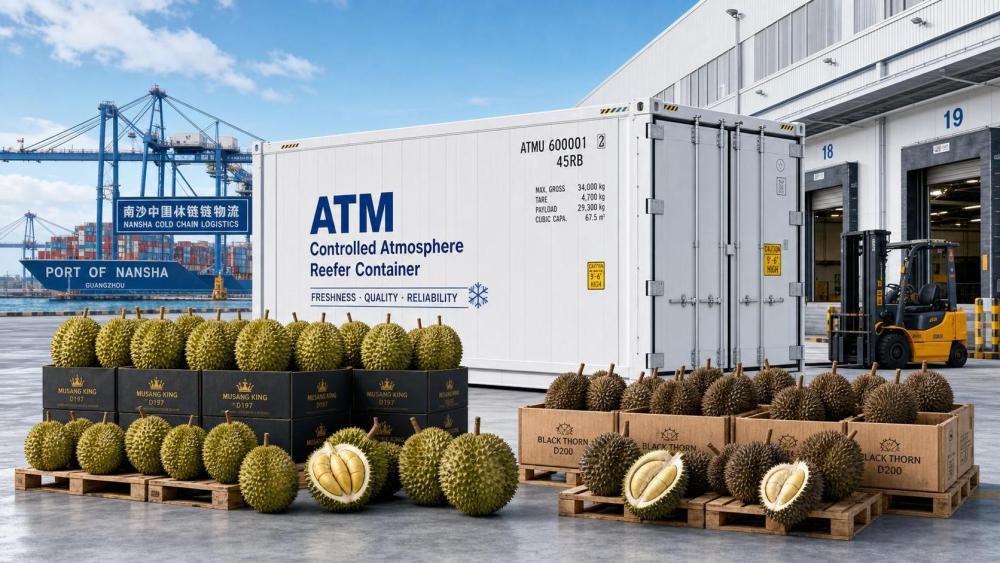
The reported shipment involved premium fresh durian varieties from Malaysia, including Musang King and Black Thorn, handled for the first time by the Guangzhou Nansha cold-chain distribution center through ATM sea freight. The process used constant temperature control together with intelligent adjustment of gas composition during transit. According to the provided summary, the arrival integrity rate reached 99.8%.
The same summary states that this shipment addressed a long-distance preservation bottleneck for tropical fresh fruit moved by sea. It also indicates that end-market prices are expected to decline by 18%. For overseas fresh produce importers, the event is described as a sign that a Chinese cold-chain hub has gained the ability to support global distribution and quality assurance for high-value agricultural products.
Where the practical impact may begin to appear
Import-side buyers may revisit sourcing and delivery assumptions
From an industry perspective, importers and direct trading companies may be affected because the reported outcome suggests that sea freight can now be considered for premium fresh durian under tightly controlled cold-chain conditions. The business impact is most likely to appear in procurement planning, route selection, landed-cost calculations, and delivery scheduling. What deserves closer attention is whether buyers begin to require clearer transport-condition records, quality-preservation documentation, and more specific delivery terms when contracting for high-value fresh fruit.
Distributors and channel operators may face new quality consistency expectations
Channel distributors and downstream circulation businesses may be affected if improved arrival condition changes expectations around shelf quality and damage tolerance. The influence would likely be felt in receiving inspection, inventory turnover planning, customer claims handling, and traceability checks. Analysis shows that these businesses should watch for changes in acceptance criteria, documentation requirements tied to cold-chain performance, and any adjustments in supplier qualification standards linked to premium imported fruit.
Cold-chain service providers may see stricter performance scrutiny
For logistics and cold-chain service providers, the event highlights the commercial importance of verifiable temperature stability and gas-composition management during ocean transit. The likely impact is not limited to equipment selection; it may extend to service specifications, handover records, condition monitoring, and proof of delivery quality. Observably, service providers should be prepared for customers to ask for more detailed operating records and clearer accountability across transport and transfer stages.
What companies should monitor next in day-to-day execution
Review how quality assurance is evidenced in documents
Analysis shows that companies involved in importing, distribution, or cold-chain delivery should pay attention to how transport stability and arrival condition are documented. The provided information confirms the use of constant temperature and intelligent gas regulation, but does not provide the detailed execution format. It is therefore more appropriate to treat documentation standards, inspection records, and supporting technical files as areas requiring continued review rather than as settled requirements.
Watch for changes in procurement specifications
Buyers handling premium fresh produce may need to examine whether procurement specifications begin to place greater weight on atmosphere-controlled shipping capability, damage control performance, and end-to-end cold-chain consistency. Since no formal rule text or contract standard is provided in the input, this should be understood as a practical monitoring point rather than a confirmed procurement rule change.
Track delivery risk allocation and after-sales handling
Where high-value perishables are concerned, any shift in transport performance can affect how parties assign responsibility for spoilage, breakage, and arrival disputes. What deserves closer attention is whether commercial terms, claim procedures, and traceability expectations start to reflect tighter quality-control benchmarks. At this stage, the input does not confirm a new mandatory framework, so businesses should monitor contract language and execution practices carefully.
Follow whether this remains a pilot signal or becomes a repeatable standard
The current information confirms a first shipment and a strong arrival result, but it does not establish a broader regulatory standard or a formal trade rule revision. Observably, companies should continue to watch for later official wording, operating guidance, or repeat use in similar cargo movements before treating this as a stable baseline for all premium tropical fruit shipments.
Why this looks more like an execution signal than a finished rule change
Analysis shows that the most meaningful aspect of this development is its operational message. It suggests that high-value imported fresh produce may increasingly be judged not only by origin and product grade, but also by whether transport conditions can be controlled and evidenced throughout the voyage. At the same time, it is more appropriate to understand this as an execution signal rather than as a fully defined policy change, because the input does not include formal regulations, certification updates, or published enforcement rules.
From an industry perspective, the reason for continued attention is straightforward: when one logistics pathway demonstrates high integrity for sensitive cargo, procurement standards, supplier screening, delivery commitments, and quality-claim expectations often become more demanding even before formal texts are updated. Whether that happens here still needs market observation.
How the market should read this development for now
For now, this event is best understood as a concrete indicator that advanced cold-chain control may be moving closer to the center of premium fresh produce trade execution. Its immediate significance lies in delivery assurance, quality preservation, and possible downstream pricing effects, all of which matter to importers and supply-chain operators.
That said, the current information does not support a definitive conclusion that a new mandatory rule system has already taken shape. A neutral reading is that the shipment provides a credible market signal with possible implications for procurement, compliance review, and service standards, while the broader execution impact still requires follow-up observation.
Basis of this article and what still needs verification
This article is based on the user-provided news title, event date, and event summary. For events of this type, relevant source categories typically include official announcements, regulatory releases, customs or trade authority information, industry association updates, standard-setting documents, and reporting by authoritative media.
No specific official source link was provided in the input, so the exact official basis still needs ongoing verification. Observably, the areas that merit continued monitoring include any later policy detail, compliance interpretation, procurement-document changes, market feedback, and how companies actually implement similar cold-chain and delivery arrangements in practice.
Related News
 Where Autonomous Freight Vehicles Deliver the Most Value in Port OperationsPort Digital Twin ArchitectAutonomous freight vehicles ports: discover where automation delivers the highest value in quay-to-yard, rail, and logistics workflows—improving throughput, safety, and reliability.
 How to Size High-Rate Sortation Capacity for Peak Parcel VolumesGlobal Routing & Distribution StrategistHigh-rate sortation capacity planning: learn how to size peak parcel throughput, reduce recirculation, protect carrier cut-offs, and build a resilient operation.
 How to Calculate Rail-Sea Intermodal Logistics Costs Before Choosing a RouteZero-Carbon Powertrain FellowRail-sea intermodal logistics cost: learn to compare all-in freight, rail, port, customs, and risk costs before choosing a route for smarter sourcing decisions.
 What Should Ports Evaluate Before Selecting a Digital Port Platform?Port Digital Twin ArchitectDigital port platform selection guide: evaluate integration, data governance, automation readiness, cybersecurity, and pilots to choose a resilient solution that improves port operations.
 How to Compare Rail-Sea Intermodal Providers for Port-to-Inland Freight ReliabilityZero-Carbon Powertrain FellowCompare rail-sea intermodal providers with a practical guide to lane reliability, capacity, visibility, costs, and contingency planning for resilient port-to-inland freight.
 How to Select Autonomous Mobile Robots for Subzero Cold Storage OperationsPort Digital Twin ArchitectAutonomous mobile robots cold storage teams can rely on: evaluate batteries, navigation, safety, charging, and service for proven subzero performance.
 How Real-Time Route Optimization Reduces Delays Across Multi-Stop Freight OperationsChief Logistics AI & Fluid Dynamics ScientistReal time route optimization helps multi-stop freight teams cut delays, protect delivery windows, and respond faster to port, warehouse, and traffic disruptions.
 How to Build a Logistics Tender Workflow That Improves Bid Quality and ControlFreight Capital & Infra Investment EconomicsLogistics tender workflow guide: improve bid quality, compare total costs, assess suppliers, and strengthen contract control for better logistics outcomes.
 How Should UAE Businesses Evaluate Drone Logistics Systems for Last-Mile Delivery?Spatial Computing & Machine Vision GeekDrone logistics systems UAE: learn how to evaluate regulatory readiness, route safety, integration, reliability, and total cost for smarter last-mile delivery.
 How to Evaluate Port Automation Systems for Container Terminal Efficiency and ROIPort Digital Twin ArchitectPort Automation Systems for terminals: evaluate efficiency, TOS integration, supplier risk, and ROI to choose scalable solutions that improve throughput and resilience.
 How to Use Freight Benchmark Pricing to Compare Carrier Rates and Control CostsFreight Capital & Infra Investment EconomicsFreight benchmark pricing helps procurement teams compare carrier rates, control total transport costs, uncover surcharges, and negotiate better freight deals with confidence.
 Container Yard Management: How to Cut Truck Turn Times and Improve Slot UtilizationPort Digital Twin ArchitectContainer yard management strategies to cut truck turn times, optimize slot utilization, reduce rehandles, and improve yard flow with smarter appointments, planning, and real-time control.