How Cold Chain Intelligence in Singapore Improves Pharma and Food Traceability




How Cold Chain Intelligence in Singapore Improves Pharma and Food Traceability
As pharmaceutical and food supply chains face tighter compliance, quality, and transparency demands, cold chain intelligence Singapore is becoming a critical advantage for business decision-makers. From real-time temperature monitoring to end-to-end data visibility across ports, warehouses, and last-mile delivery, intelligent cold-chain systems help reduce spoilage, strengthen traceability, and support regulatory confidence in one of Asia’s most strategic logistics hubs.
The point is not simply to know whether a cold room stayed cold. In Singapore, the harder question is whether a shipment remained within the right condition envelope while moving through handoffs that are operationally efficient but easy to underestimate: port discharge, customs clearance, cross-dock staging, airport transfer, urban delivery windows, and short dwell times that can still cause temperature drift if packaging and monitoring are poorly matched. That is where intelligence matters. It turns isolated temperature readings into a chain of custody that can actually be audited and trusted.
For pharmaceuticals, traceability is usually less forgiving because product integrity can depend on narrow temperature bands, documented excursion handling, and evidence that each transfer point was controlled rather than assumed to be controlled. Food logistics often has a different pattern. The tolerances may vary by product category, but volume is higher, turnaround is faster, and the most common failures tend to come from door openings, staging delays, mixed-load practices, and weak visibility between imported cargo and domestic distribution. Both sectors need monitoring. They do not need the same monitoring logic.
Where the Real Traceability Problem Starts
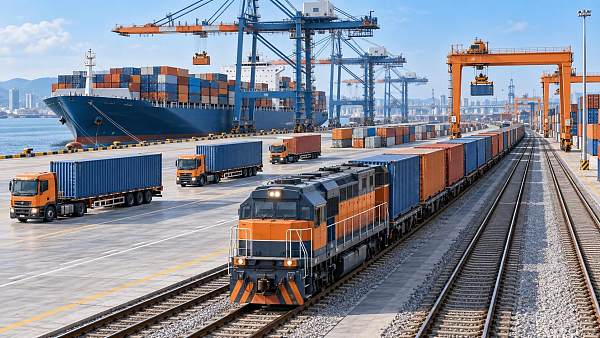
A sealed reefer container arriving at a port can look compliant on paper while still leaving a traceability gap. Container-level readings may confirm that setpoint conditions were maintained during the ocean leg, but that does not automatically prove what happened after unloading, during inspection, while waiting for a truck slot, or when cargo was transferred into a warehouse zone with different airflow characteristics. In practice, many disputes begin at these boundaries. One data stream ends, another begins, and the chain between them is weak.
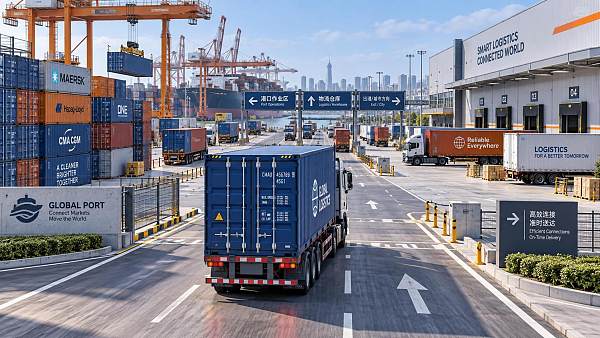
Singapore’s advantage is that it concentrates advanced logistics infrastructure in a relatively compact geography. The same density that improves throughput also raises expectations. If transit times between nodes are short, then a temperature excursion caused by poor loading discipline or an unreconciled sensor record becomes harder to excuse. Intelligent cold-chain systems are valuable here because they connect event data to location, timestamp, and handling context. A deviation during final-mile delivery means something different from a deviation while a pallet waits outside a pharmaceutical staging chamber for relabeling or documentation review.
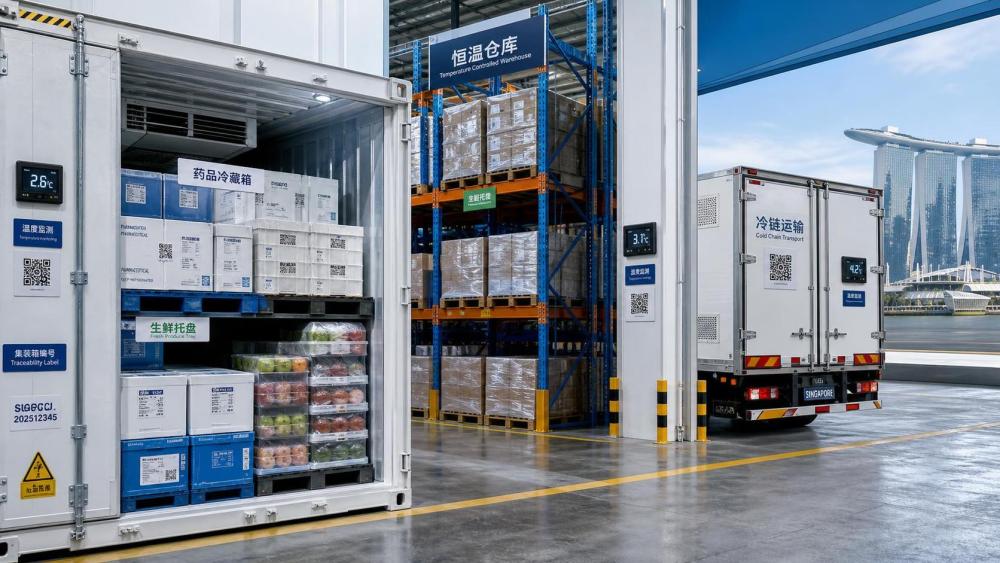
That distinction matters during investigations. A quality team does not just want an alert; it wants to know whether the issue came from packaging failure, route delay, equipment instability, repeated door openings, or a mismatch between product profile and storage zone. Without that layer of interpretation, “visibility” becomes a dashboard term rather than an operational control.
Pharma Needs More Than Live Temperature Data
In pharmaceutical logistics, real-time monitoring is useful but incomplete if it is not tied to documented process controls. A shipment of vaccines, biologics, clinical materials, or temperature-sensitive finished drugs typically moves through validated packaging, conditioned storage, controlled transfer windows, and release procedures shaped by quality management requirements. When operators in Singapore discuss traceability, the serious conversations are usually about data defensibility: who recorded the condition, whether the device was appropriate for the shipment, how alerts were escalated, and whether any excursion assessment can stand up to internal QA review or external regulatory scrutiny.
This is why pharma projects often prioritize calibrated sensors, tamper-evident data records, and integration with warehouse execution or quality documentation workflows, not just telematics. If a sensor reports a brief temperature spike, the next question is rarely “did the alert fire.” It is whether the spike occurred in the product mass, the packaging exterior, or the ambient environment during a known handling step. Operators who have worked these flows know that sensor placement and packaging design can distort the story if they are chosen for convenience rather than for the thermal behavior of the product.
Singapore’s role as a regional transshipment and air cargo hub adds another layer. Cargo may not remain in-country for long, but even short dwell periods require clear accountability. The more transfer points involved, the more valuable it becomes to have a single event trail that links reefer release, warehouse receipt, chamber storage, order picking, and outbound dispatch. In this setting, cold chain intelligence Singapore is less about adding another screen to watch and more about removing ambiguity before ambiguity turns into product quarantine.
Food Traceability Has a Different Failure Pattern
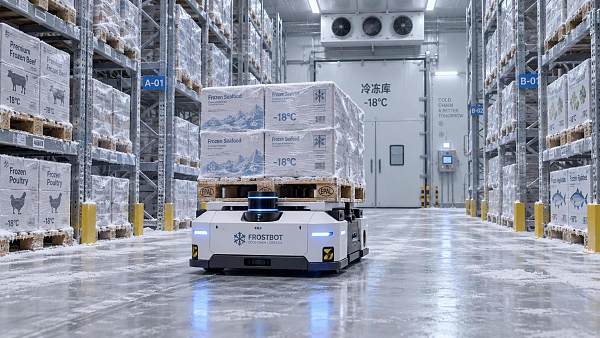
Food operators usually face a broader mix of SKU profiles and a more uneven temperature risk pattern. Chilled seafood, frozen meat, fresh produce, dairy, and ready-to-eat imports do not react to delays in the same way, and they rarely move through identical handling routines. The weak point is often not long-haul refrigeration; it is the accumulation of small operational losses. A loading bay door remains open because the next truck arrived early. Product is staged in the wrong zone during peak inbound activity. A mixed consignment creates confusion about which pallets require faster putaway. None of these events sounds dramatic, but they are exactly the kind of events that erode traceability and shelf-life confidence.
For food supply chains, intelligent cold-chain systems are most useful when they combine sensor inputs with process checkpoints. Time out of refrigeration, loading sequence, dwell duration by zone, truck arrival variance, and proof of delivery can be more revealing than temperature alone. Many operators discover that spoilage claims are not caused by a single catastrophic equipment failure. They come from repeated micro-excursions that standard logs fail to contextualize.
That is also why a warehouse that performs well for frozen imports may still struggle with fresh or chilled products. Frozen cargo is often more tolerant of brief handling variation than chilled food with narrow freshness windows. A decision-maker comparing sites or service providers should ask how the operation distinguishes product classes in practice: separate staging rules, different alarm thresholds, route planning tied to cargo type, and evidence that exceptions are managed before delivery disputes arise.
The Site Conditions That Change the System Design
Cold-chain intelligence is never just a software decision. Site conditions in Singapore push the system design in very specific directions. Humid tropical ambient conditions can make transfer exposure more consequential than operators expect, particularly when products move between vehicles and temperature-controlled interiors. High-throughput urban logistics also means equipment is used hard: doors cycle frequently, docks stay busy, and labor teams may prioritize speed unless workflows are engineered to make compliant handling the faster choice.
A few design questions usually separate a robust deployment from a superficial one:
These are not minor implementation details. They determine whether traceability supports root-cause analysis or just produces more records to store.
What Buyers Often Misjudge
A common mistake is assuming that more sensors automatically mean better control. In reality, uncontrolled data proliferation can make investigations harder. If timestamps are unsynchronized, alerts are too frequent to triage, or devices are deployed without a clear ownership model, teams stop trusting the system. For regulated pharma, that is a quality risk. For food, it becomes an operational nuisance that people work around.
Another misjudgment is to focus on the cold room and neglect the loading interface. Many temperature losses happen where conditioned spaces meet human activity: dock shelters, transfer corridors, truck loading zones, and unpack areas. A site may have compliant refrigeration assets and still perform badly because the handoff choreography is weak. Cold chain intelligence should therefore include workflow visibility, not just refrigeration status.
There is also a tendency to treat traceability as a post-incident reporting tool. That underuses the system. The better operators use live and historical data to tune dock schedules, choose packaging profiles, separate high-risk SKUs, and identify which routes or subcontracted legs create repeated exceptions. Those decisions are often more valuable than the dashboard itself.
How to Judge Fit Before Expanding the System
Before scaling any cold-chain intelligence deployment, it helps to test whether the system can answer a small set of operationally hard questions. Can it show where chain-of-custody responsibility changed? Can it distinguish a packaging issue from a facility issue? Can quality, warehouse, and transport teams see the same event history without manually reconciling spreadsheets? Can a customer complaint be investigated against time, place, and handling records rather than assumptions?
If the answer is no, the issue is usually not a lack of monitoring hardware. It is a mismatch between data design and the actual movement pattern of the cargo. That is especially relevant in Singapore, where multimodal transfers and fast turnaround compress the time available to recover from small errors. Systems should be chosen around the critical breakpoints in the journey, not around generic feature lists.
For teams evaluating providers or internal upgrades, the most useful next step is often a lane-by-lane review rather than a broad digital transformation brief. Map the highest-risk pharmaceutical flows and the most complaint-prone food lanes. Identify where evidence becomes weak, where alerts are not actionable, and where product classes are being handled with the same logic when they should not be. That exercise usually reveals whether cold chain intelligence Singapore will deliver real traceability gains or just add another layer of unconnected telemetry.
Related News
 Where Autonomous Freight Vehicles Deliver the Most Value in Port OperationsPort Digital Twin ArchitectAutonomous freight vehicles ports: discover where automation delivers the highest value in quay-to-yard, rail, and logistics workflows—improving throughput, safety, and reliability.
 How to Size High-Rate Sortation Capacity for Peak Parcel VolumesGlobal Routing & Distribution StrategistHigh-rate sortation capacity planning: learn how to size peak parcel throughput, reduce recirculation, protect carrier cut-offs, and build a resilient operation.
 How to Calculate Rail-Sea Intermodal Logistics Costs Before Choosing a RouteZero-Carbon Powertrain FellowRail-sea intermodal logistics cost: learn to compare all-in freight, rail, port, customs, and risk costs before choosing a route for smarter sourcing decisions.
 What Should Ports Evaluate Before Selecting a Digital Port Platform?Port Digital Twin ArchitectDigital port platform selection guide: evaluate integration, data governance, automation readiness, cybersecurity, and pilots to choose a resilient solution that improves port operations.
 How to Compare Rail-Sea Intermodal Providers for Port-to-Inland Freight ReliabilityZero-Carbon Powertrain FellowCompare rail-sea intermodal providers with a practical guide to lane reliability, capacity, visibility, costs, and contingency planning for resilient port-to-inland freight.
 How to Select Autonomous Mobile Robots for Subzero Cold Storage OperationsPort Digital Twin ArchitectAutonomous mobile robots cold storage teams can rely on: evaluate batteries, navigation, safety, charging, and service for proven subzero performance.
 How Real-Time Route Optimization Reduces Delays Across Multi-Stop Freight OperationsChief Logistics AI & Fluid Dynamics ScientistReal time route optimization helps multi-stop freight teams cut delays, protect delivery windows, and respond faster to port, warehouse, and traffic disruptions.
 How to Build a Logistics Tender Workflow That Improves Bid Quality and ControlFreight Capital & Infra Investment EconomicsLogistics tender workflow guide: improve bid quality, compare total costs, assess suppliers, and strengthen contract control for better logistics outcomes.
 How Should UAE Businesses Evaluate Drone Logistics Systems for Last-Mile Delivery?Spatial Computing & Machine Vision GeekDrone logistics systems UAE: learn how to evaluate regulatory readiness, route safety, integration, reliability, and total cost for smarter last-mile delivery.
 How to Evaluate Port Automation Systems for Container Terminal Efficiency and ROIPort Digital Twin ArchitectPort Automation Systems for terminals: evaluate efficiency, TOS integration, supplier risk, and ROI to choose scalable solutions that improve throughput and resilience.
 How to Use Freight Benchmark Pricing to Compare Carrier Rates and Control CostsFreight Capital & Infra Investment EconomicsFreight benchmark pricing helps procurement teams compare carrier rates, control total transport costs, uncover surcharges, and negotiate better freight deals with confidence.
 Container Yard Management: How to Cut Truck Turn Times and Improve Slot UtilizationPort Digital Twin ArchitectContainer yard management strategies to cut truck turn times, optimize slot utilization, reduce rehandles, and improve yard flow with smarter appointments, planning, and real-time control.